Hypothesis 3: Self-help group resilience is strengthened by a revolving loan and disaster response fund
This hypothesis is the main crux of the project activities. Two innovations were developed as a part of this project to test hypothesis 3: a revolving loan and a disaster response fund layered to existing SHG operations.
A revolving loan was delivered to 98 SHGs: 49 in rural settings (in the south of Rwanda) and 49 in urban settings in Kigali who signed repayment contracts with Tearfund. Each SHG received a loan of 600,000 RWF, with an interest rate of two per cent, to be paid back over 12 months. The revolving loan has built resilience in the following ways:
Evidence that the revolving loan built resilience of SHGs (as a group):
- Internal guidelines for loan distribution and a group contract for loan repayment improved financial literacy and management of external funds and loans.
- From 98 SHGs, 1,385 members received the loans (78 per cent were women); the loans were used to expand existing small businesses or start new ones, and restart saving and loaning within the SHG framework.
Evidence that the revolving loan built resilience of members, contributing to group resilience:
Anecdotal evidence suggests that the loan had an impact on addressing sexual and gender-based violence (SGBV). Feedback from stakeholders was that ‘the revolving loan gives the value of women a boost’. Extensive evidence has proven the role of SHGs in addressing gender-based violence and raising the status of women. However, the pandemic has shown that this is often intrinsically linked 2 3 to women’s ability to meet and contribute to household income. Therefore, this project was a good, short-term adaptation in restoring the benefits of SHGs, and protecting women. However, further work needs to take place in changing attitudes towards women and girls; to understand their value even when they are not able to contribute to household income, addressing the root causes of SGBV. Tearfund recommends running the Transforming Masculinities approach alongside SHGs and within communities to address this.
Case study
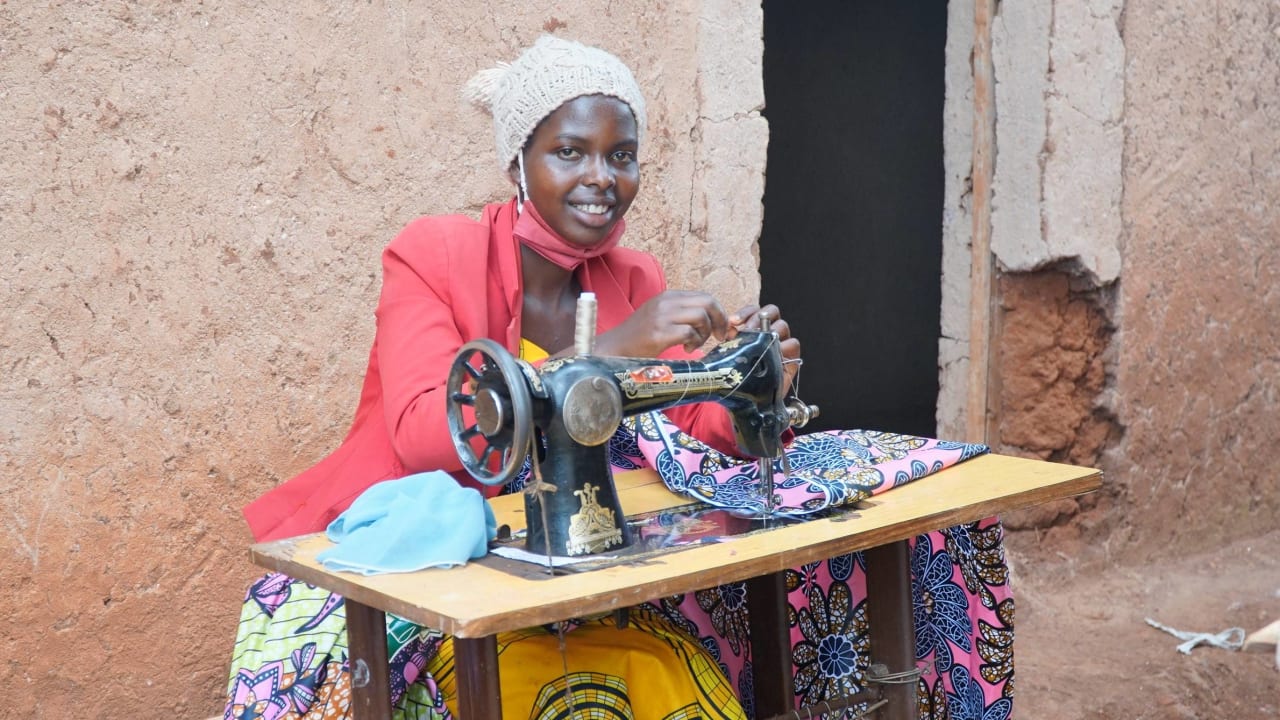
Josephine is an SHG member who works as a tailor to support herself and her family. The lockdown and subsequent restrictions bankrupted her business. Josephine’s SHG was provided with a loan, and Josephine was able to use 50,000 RWF of the loan to buy some materials and reinvest in her business: ‘Now I make around 2,500 RWF per day, which allows me to provide for my family and repay the loan.’
Disaster response fund:
The second innovation towards this hypothesis was the disaster response fund. This was designed to encourage SHGs to save a small amount for disasters, so that there is a separate pot that can be used to distribute funds during a crisis, and not to absorb all funds in the instance of a disaster, as in the first Covid-19 lockdown. SHGs will develop and maintain these funds, but will receive a top-up from the revolving loan once all target SHGs have received the loan.
Evidence that disaster response fund builds resilience:
Since the start of the project, 57 SHGs established functional disaster response funds to support members and the community at large. SHGs managed to support 27 people affected by disasters, including the elderly and those living with disabilities.
Case study
Tuzamurane Kadahokwa self-help group rehabilitating the bridge Nkundimana Vincent, African Evangelical Enterprise Localised flooding hugely impacts the efficiency of SHGs. Groups meet in communities with poor roads, and face access challenges meaning members cannot attend meetings or access markets for business activities. Flooding in December destroyed a bridge in a community in Huye (southern district). With the loan provided by this project, an SHG rehabilitated the bridge, enabling business to be resumed uninterrupted by flooding, and building resilience of the group.