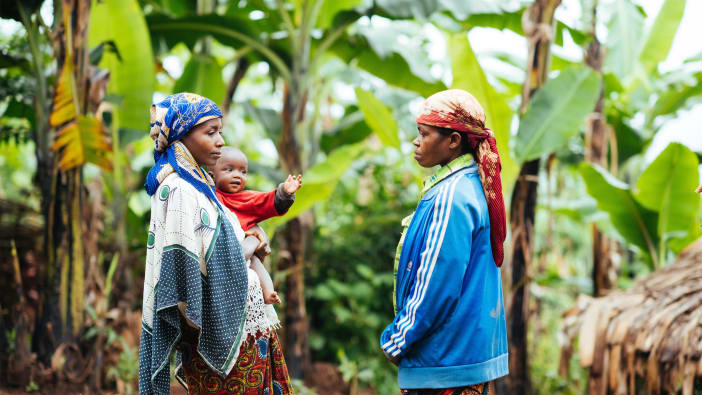
The Journey to Healing (J2H) approach has been shaped and developed by extensive research and practice in communities across the world. It is therefore rooted in the lived experience and expertise of many survivors and their champions. Adapting J2H to different contexts is vital to ensure it is meaningful and relevant, but it is also important to remain faithful to J2H’s core values and approach.
This document is essential reading when you come to consider how to adapt J2H for your context. It details the non-negotiable elements that are core to J2H's framework and the parts of the J2H approach that can be changed to make it more locally relevant, effective or logistically feasible.
Following these guidelines ensures that the approach remains effective in all the contexts in which it is implemented, regardless of who is implementing it.
Tools and guides
Journey to Healing: Maintain the essential elements
Guidelines for preserving core elements of Journey to Healing and adapting to local contexts for effective implementation
2026 Available in English
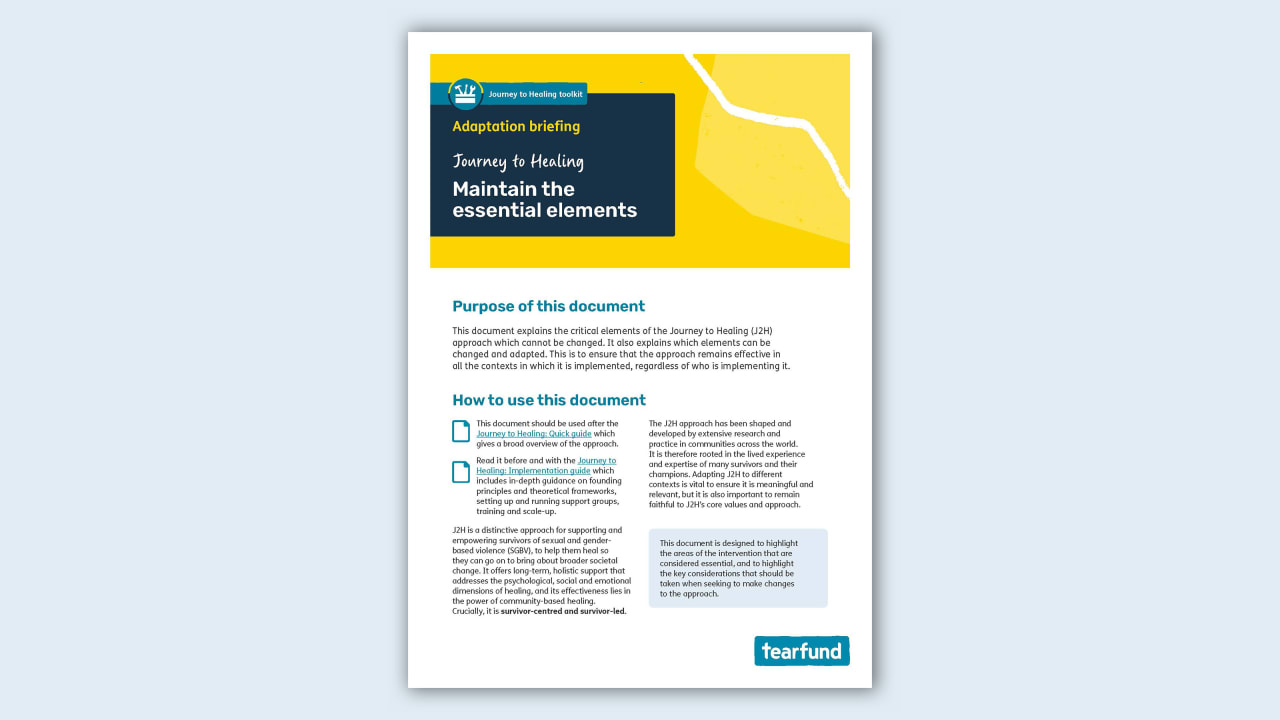
Adaptation briefing
From: Journey to Healing toolkit
Resources for the Journey to Healing approach, creating safe spaces for healing from sexual and gender-based violence (SGBV).
Key considerations for implementation
Successfully implementing the J2H approach requires careful attention to these specific elements:
Upholding core values: All interventions must rigorously adhere to J2H’s core values and principles, which are: mutual respect, individualisation, self-determination, non-judgemental attitude, trust and confidentiality.
Part 1 of the implementation guide outlines J2H core values, principles and theoretical frameworks.
Including the key components of programmatic
design: These include trauma-informed care, survivor-centred approaches, customised healing plans, and nurturing and accompaniment.
Part 2 of the implementation guide provides more detail on the key components to be considered in designing programmes.
Psychological support: J2H facilitators and survivor champions need to be trained in giving survivors the tools and techniques they need to start to understand their trauma responses and learn to cope with them.
They also need to know how to avoid any form of re-traumatisation or exploitation.
Part 3 of the implementation guide includes a section on psychological support and essential tools and techniques.
Referral pathways: It is vital to ensure clear, accessible and respectful referral pathways to help survivors access specialised legal, medical, psychological and livelihood services. J2H is about addressing the holistic needs of survivors, looking beyond what the peer support groups can provide.
Parts 3 and 5 of the implementation guide include more details on building support systems that extend beyond the peer support groups.
Mobilising resources sustainably: If any J2H programme is to be sustained and grow in a way that remains true to the heart of J2H, it is important to plan carefully. This means considering how to ensure the programme has enough resources, including through ‘training of trainers’ and careful budgeting. It also involves offering sustained and comprehensive support to survivor champions.
Parts 4 and 5 of the implementation guide focus on training and scale-up.
Similarly Tagged Content


Have you used this resource?
We’d love to hear how it helped you. Your feedback helps us improve and share more of what matters.

Get our email updates
Be the first to hear about our latest learning and resources
Sign up now - Get our email updatesRelated Resources
-
Tools and guides
Facilitation skills workbook – a Pillars resource

Training material for people using Pillars guides in their local communities
Available in 4 languages
-

Tools and guides
How to save for the future
Saving money for the future can help to avoid situations where we cannot pay for the things we need
Available in 4 languages
-
Tools and guides
How to create a budget
Three steps to creating a household budget: plan and keep track of your income, spending and saving
Available in 4 languages