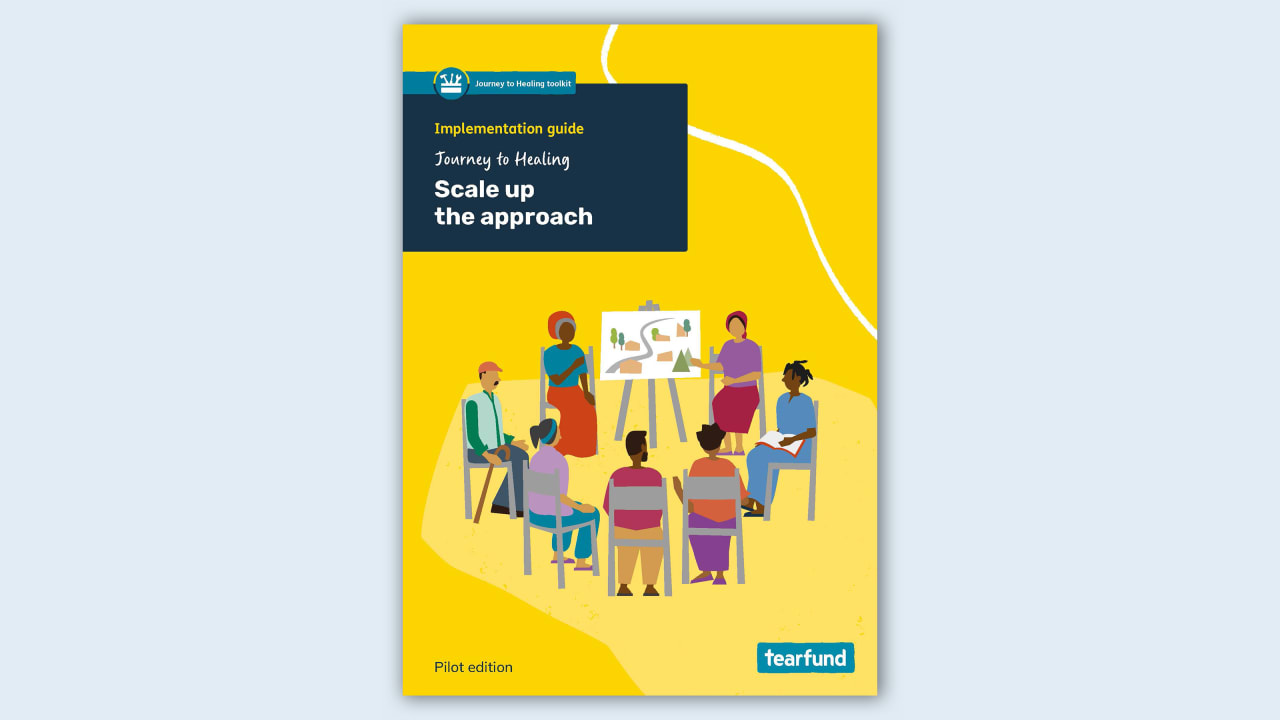

Welcome to the Journey to Healing (J2H) implementation guide. This comprehensive resource is designed to provide you with the tools and understanding you need to be able to walk alongside survivors of sexual and gender-based violence (SGBV) and to lead survivor-centred processes where healing is not only possible but also profound.
Who is this guide for?
This guide is for survivor champions, and anyone wanting to facilitate or manage a J2H programme, or to integrate SGBV interventions into other thematic areas. This could be Tearfund staff, Tearfund partner staff or trained faith/community leaders dedicated to supporting survivors of SGBV through their healing journey. For simplicity’s sake, we will refer to ‘survivor champions’ and ‘facilitators’.
- Survivor champions are survivors who have journeyed through their own healing and are ready to mentor others. They receive training, based on this guide, to form peer support groups and ideally develop networks of survivor groups, contributing to a global movement rooted in solidarity and hope. Typically, support groups are set up and run by survivor champions.
- Facilitators are trained using this guide to provide effective supervision, training and support to survivor champions. Their role is to manage and monitor J2H programme implementation, ensuring quality control, appropriate contextualisation (adapting resources and approaches to the local context) and adherence to the core values of J2H.
Through a powerful cycle of healing, leadership development and community building, the J2H approach enables both individual healing and community transformation.
Your role as a facilitator or survivor champion is vital and we are rooting for you! So take the next step and lead with confidence, knowing that you are making a profound difference in the lives of survivors. Speak out, take action and be a part of the change we all want to see.