Skip to content Skip to cookie consent
Skip to content

Tools and guides

Managing business money

Lessons on business budgeting for profit, savings and growth to help your business flourish

Written by Mawousse Tchegnon 2025 Available in English, French, Spanish and Portuguese

A woman in Togo sits next to her sewing machine inside her tailoring shop.

Bataka Lébènin in Togo has a flourishing business now she has learnt to keep careful records of income and expenditure. Photo: Mawoussé Tchegnon/Chalmers Center

A Thai woman behind the counter of a shop writes down the detail of a sale as she serves a smiling female customer.

From: Managing money – Footsteps 124

Managing money effectively is an important skill for individuals, households and businesses

Bataka Lébènin is a member of the savings group Femmes Sages (Wise Women) in Togo. She owns a small tailoring business and also sells fabric.

Bataka did not know how to manage her money well, which caused many problems. She mixed the money she earned from the business with her household money, so she did not know if she was making or losing money. She kept investing more money into the business, but she did not see any improvement.

In 2023, she and the other members of her savings group were given the option to receive business training using a curriculum developed by Chalmers Center. It was then that she started to keep careful records and plan all her expenses. 

Once she had learnt how to calculate profit and to separate household and business money, she discovered that her apprentice was stealing money from her. She was able to address this problem, and now her business is flourishing.

Lena the baker

Part of the business training that Bataka received uses the example of a fictional baker called Lena. 

Lena makes and delivers bread every day. The shopkeepers pay her for the bread and then place orders for the following day. 

When she gets home, Lena puts the money from her sales in a locked cash box, hidden in her house. Twice a week, Lena counts her money to see how much she has received. 

Today, she checks the supplies for her business and decides she needs flour, yeast, salt and sugar. Lena also checks what food and other items her family needs. The list includes rice, soap, sugar, school notebooks and a new broom. Lena realises that she does not have enough money to buy everything and decides that the new broom can wait until another time. 

Lena puts the money to buy business supplies in a red purse, and the money for the household expenses in a blue purse. Then Lena goes shopping to buy business and family supplies.

Keeping track

Here is how Lena keeps track of her money.

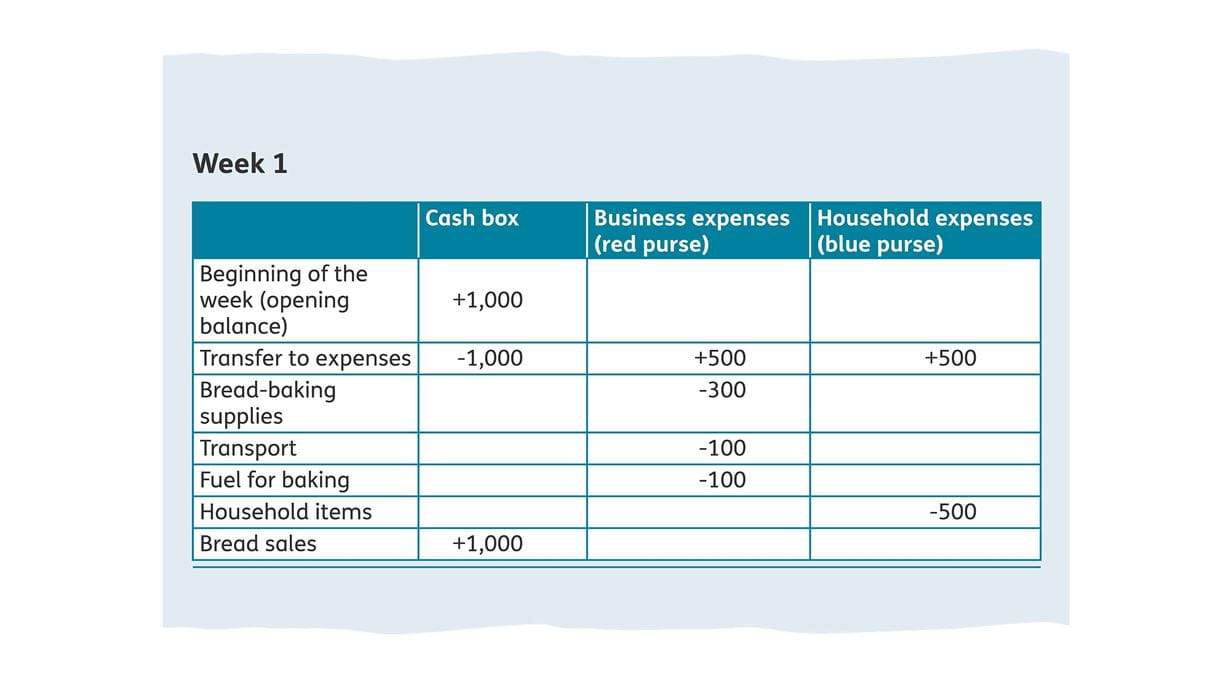
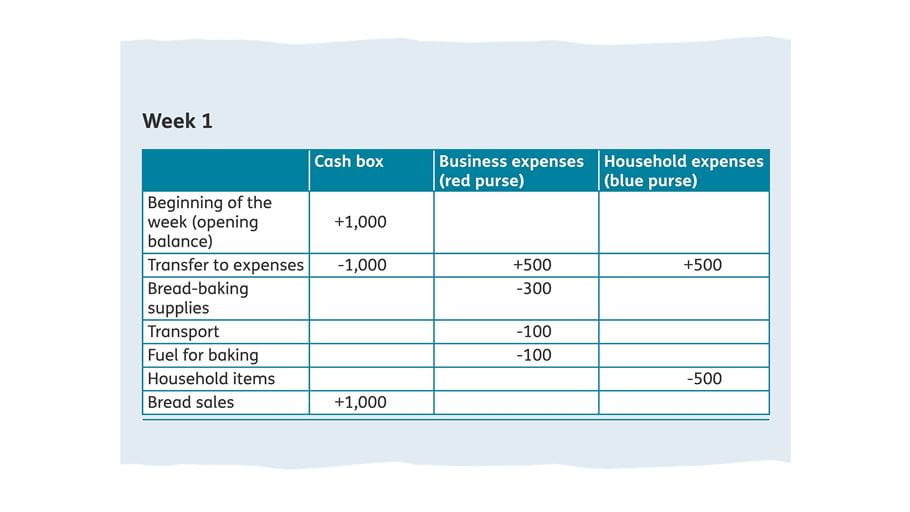
  • At the beginning of the week, Lena has 1,000 in her cash box. This money is her earnings from the previous week. Lena decides to spend 500 on her business, and 500 on household expenses.
  • During the week, Lena spends 300 on bread-baking supplies, 100 on transport and 100 on fuel for baking.
  • Lena spends 500 on food and other items for her family.
  • Lena sells 200 loaves of bread at 5 each for a total cash amount of 1,000.
  • At the end of the week she has 1,000 in her cash box.
spread sheet illustrating savings and profits

Week 1 expenses sheet

Calculating week 1 profit

Lena wonders how much profit she has made from her weekly sales. She knows that money coming into the business from sales is not the same as profit.
Lena’s business is profitable but not growing, because she begins and ends the week with the same amount of money (1,000). She invests the same amount in materials every week (500) and makes the same amount of profit (500).

Business growth

Lena decides to take out a low-interest loan of 1,000 from her savings and credit group to help her business grow. She plans to spend the whole amount on her business, so she puts it straight into the business expenses purse.

Here are the transactions for week 2.

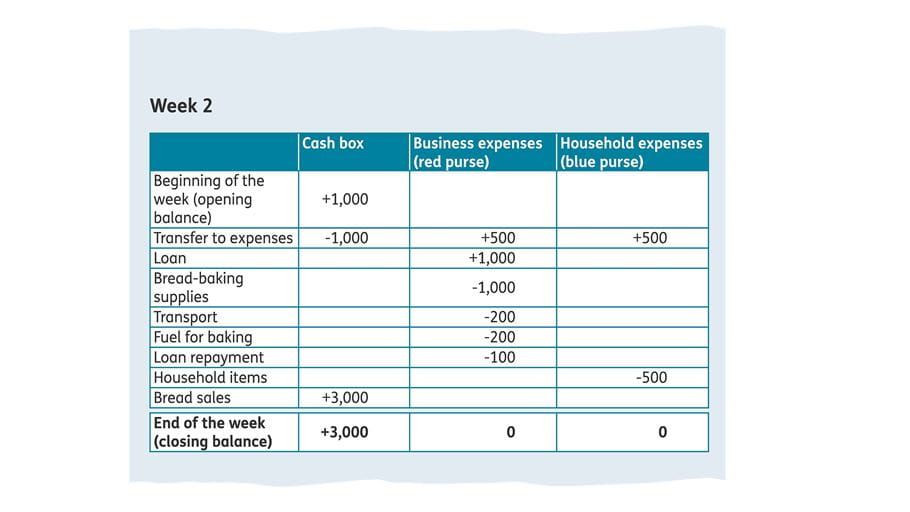
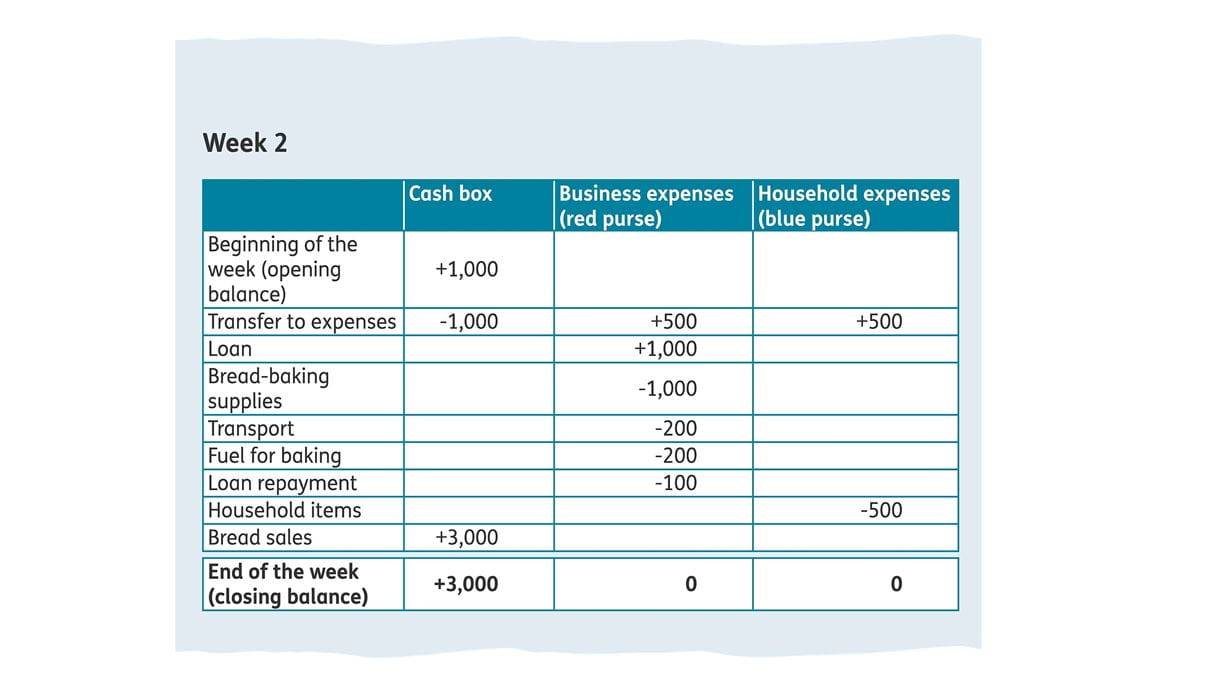
  • At the beginning of the week, Lena has 1,000 in her cash box (the earnings from the week before). 
  • She spends 500 of this on household expenses.
  • Using the loan money, Lena spends 1,000 on bread-baking supplies instead of her usual amount of 300. She also spends 200 on transport, 200 on fuel for baking and 100 on her weekly loan repayment.
  • Lena sells 600 loaves of bread at 5 each, for a total cash amount of 3,000.
spread sheet illustrating savings and profits

Week 2 expenses sheet

Calculating week 2 profit

To keep her business going at the same level, Lena now needs to put 1,500 back into the business each week. She also needs to make decisions about how to use her profit wisely. 

She can use the profit to:

  • grow the business further
  • pay for household expenses
  • save for the future 
  • do a combination of these

Savings

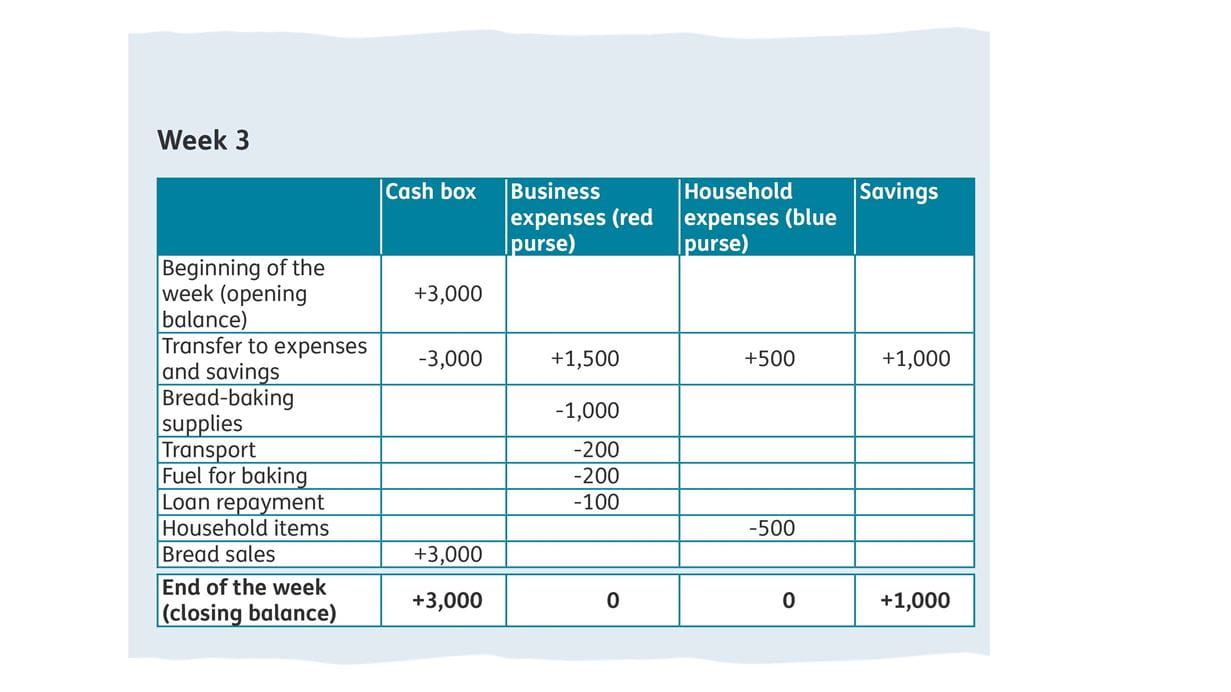
Lena decides that she wants to start building up her savings in case there is an unexpected emergency at home. These are her transactions for week 3.

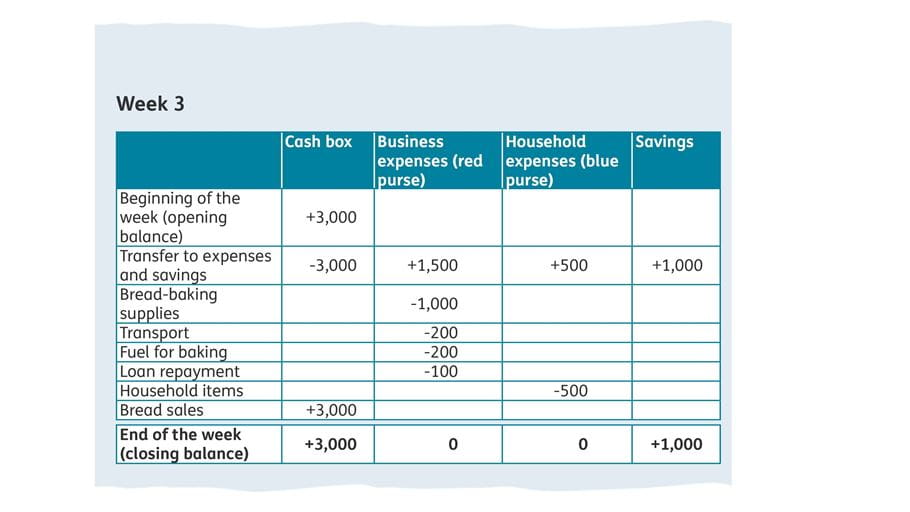
  • At the beginning of the week, Lena has 3,000 in her cash box. 
  • Based on her expenses the previous week, she decides to spend 1,500 on her business and 500 on household expenses. This leaves her with 1,000 that she puts into the bank as savings.
  • During the week Lena spends 1,000 on bread-baking supplies, 200 on transport, 200 on fuel and 100 on her weekly loan repayment.
  • Lena sells 600 loaves of bread at 5 each, for a total cash amount of 3,000.

Lena’s profit is the same as last week (1,500), but she has also managed to save 1,000. Next week, if everything stays the same, she will be able to save another 1,000, or she may decide to invest more in the business so it continues to grow. 

Before making this decision, Lena needs to think about whether she has time to bake and sell more bread, and also if there are enough people who want to buy her extra bread. If her business continues to grow, she might decide to employ someone to help her.

spread sheet illustrating savings and profits

Week 3 expenses sheet

Other languages

Discussion questions

  • What are examples of household expenses?
  • What are examples of business expenses?
  • If you own a business, how can you keep your household and business money separate? Why is this important?
  • Why did Lena’s business grow and her profit increase?
  • What are the good decisions she made?
  • Would you have done anything differently?

Learn more

Managing cash flow  How to avoid a situation where you have a bill to pay but not enough money. 

Savings and credit groups – Footsteps 123 How meeting together to save money, access loans and provide mutual support can result in significant positive change. 

Visit learn.tearfund.org and search for the relevant title.

Written by

Written by  Mawousse Tchegnon

Mawousse Tchegnon is the Director of West Africa Operations for Chalmers Center.


Lena’s story is an adapted extract from Chalmers Center’s ‘Manage your business money’ training module, which also includes reflections on what the Bible says about managing money well. To find out more and access the whole Business and Home curriculum, visit chalmers.org/business

Similarly Tagged Content

Subscribe to Footsteps magazine

A free digital and print magazine for community development workers. Covering a diverse range of topics, it is published three times a year.

Sign up now - Subscribe to Footsteps magazine